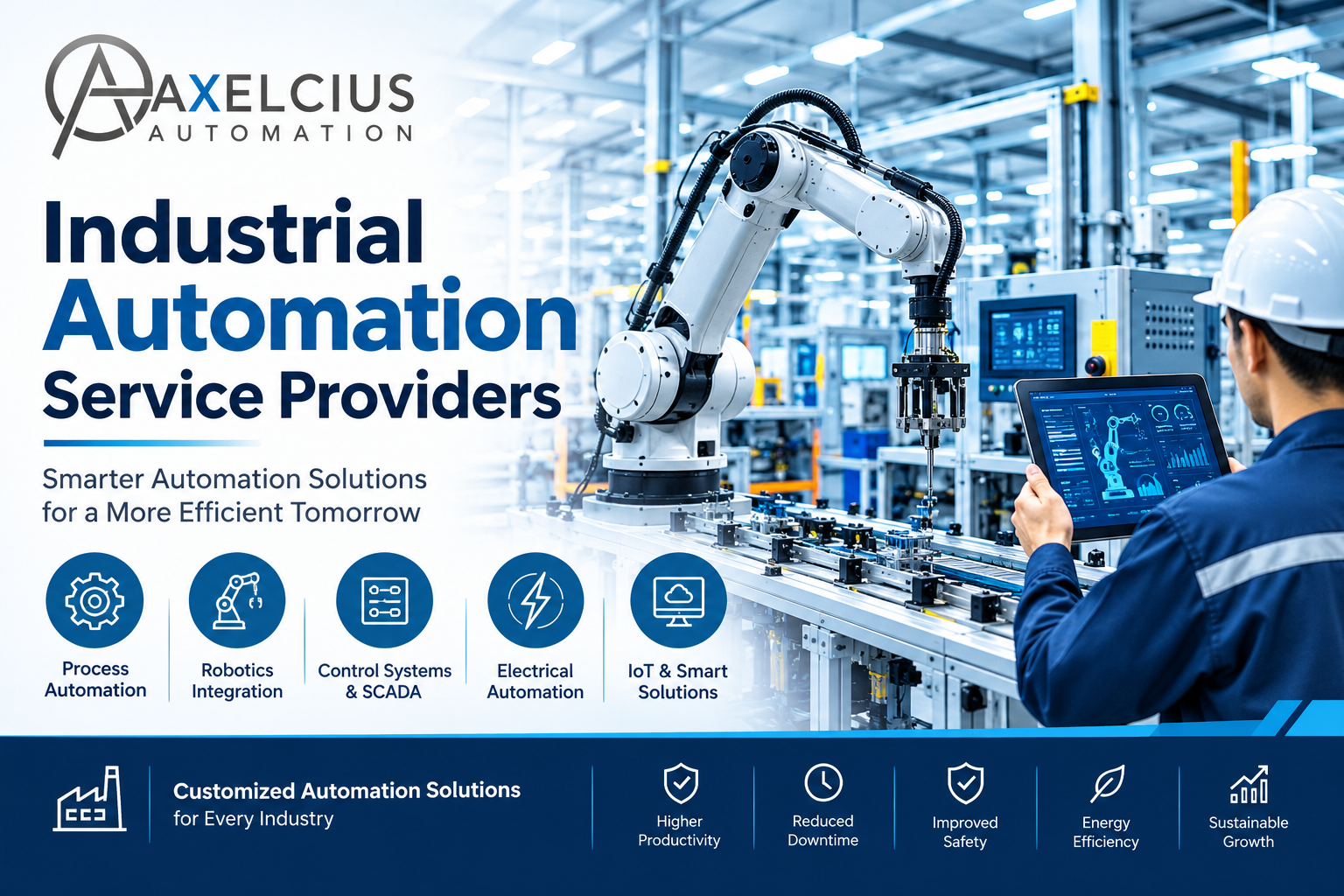
Industrial Automation Service Providers for Reliable Systems
By: Super Admin | Date: August 21, 2026
Industrial processes require dependable machinery, electrical equipment, control devices and monitoring technology in order to ensure that the processes run in a consistent manner. With the advancement of industrial processes, manufacturing companies require integrated automation systems that can control equipment, monitor processes and better control industrial processes.
Industrial Automation Service Providers We can help with the design, integration, commissioning and providing ongoing service for Automation Solutions for Industries Systems. We can help you wire, connect and integrate PLC's, HMI's, VFD's, field sensors, control panels, field instruments and other components into a dynamic industrial network.Learn about the function, technologies, advantages, uses, and critical elements to think about when choosing reliable industrial Highway Electrical Automation Service Providers services in this article.
Understanding Industrial Automation Services
Industrial Automation Service Providers is the use of control systems and information technology to handle different processes and machinery in an industry to replace manual effort. Not only to automate a machine but to develop a system that consists of various equipment which can communicate with each other and coordinate.
Process Automation Solutions for Industries are knowledgeable about industrial processes and assist companies in choosing the right automation systems based on their needs. This may include the designing, electrical control, programming, integrating, testing, installing, commissioning and maintenance of an automation system.A well-designed Industrial Automation Service Providers system can ensure there is improved visibility of processes, as well as assisting operators in the management of equipment by way of centralised controls and monitoring.
Role of Industrial Automation Service Providers
Benefits of Highway Electrical Automation Service Providers Solutions An automation provider not only provides you with an automation solution, but they are also involved with the process requirements of the client and in the development and support of the final automation system.
Established Industrial Automation Service Providers evaluate these needs before any automation solution is created. They can help team electrical control equipment, hardware, software, instrumentation, and interaction systems into an organized plan.
Key responsibilities may include:
Automation system design and engineering
PLC and HMI programming
SCADA development and monitoring
Control panel design and integration
VFD-based motor control
Sensor and field-instrument integration
System testing and commissioning
Troubleshooting and technical support
This full method enables teams to maintain a better control of their industrial processes.
Core Technologies Used in Industrial Automation
Modern automation projects combine several technologies. The selection depends on the process, equipment, production requirements, and desired level of monitoring.
Technology | Primary Function | Industrial Use |
PLC | Automated control | Machine and process control |
HMI | Operator interface | Equipment monitoring and control |
SCADA | Supervisory monitoring | Process visualisation and data management |
VFD | Motor control | Speed and motor operation management |
Sensors | Process detection | Measurement and monitoring |
Control Panels | Electrical control | Centralised equipment management |
Field Instruments | Parameter measurement | Industrial process monitoring |
When these technologies are properly integrated, operators can receive useful information about equipment and processes from a centralised interface.
Benefits of Reliable Industrial Automation
Industrial Automation Service Providers can yield several operational gains when it has been effectively designed and installed. An optimization factor for automation is stability. An electronic control, for example, can carry out repetitive control tasks over an extended period according to predefined settings.
In addition, certain advantages include: Better monitoring The operators can keep the eye on the process conditions, alarms, equipment status and other information through the HMI or SCADA screen.
Reliable automation can also support:
Better process control
Reduced repetitive manual activities
Improved operational visibility
Consistent machine performance
Faster identification of equipment issues
Better utilisation of industrial resources
Easier monitoring of multiple processes
Real gain would hinge on good system design, installation, choice of equipment, and continuous upkeep.
Automation Solutions for Industries
Automation Solutions for Industries can be designed for multiple types of manufacturing environments. Infrastructure Automation can be designed for the unique architectural needs of the facility.Manufacturing plants may employ automation to operate their manufacturing machines, for storing the materials, controlling motor operations, keeping track of the process, and distributing the electrical power. Process industries may employ automation to oversee the parameters and varying of the production stages.
Additional uses include power stations, cement factories, chemical plants, pulp and paper factories, sugar plants, railways and road development.A well-selected mix of PLC, HMI, SCADA, VFD, sensors, control panel, and field instrumentation provides a controlled well-organised environment matching the operation needs of each industry.
Importance of System Integration
Industrial Automation Service Providers are enabled by synergies between the pieces when they work seamlessly together as a singular integrated system. System Integration- Utilizes the connection of hardware and software, electrical equipment, instruments and communication networks.
For example, sensors can feed process data to a PLC, the PLC can process the data based on programmed logic, and an HMI or SCADA can display the information to operators.
This comprehensive solution enables companies to oversee and manage separate parts of an operation from a single organized portal. Proper integration also prevents too many communication gaps between individual pieces.
Highway and Infrastructure Automation
Infrastructure automation projects typically have special requirements, as the equipment is usually distributed electrical and monitoring gear. Highway Electrical Automation Service Providers Contractors are familiar with the infrastructure environment, where trusted data transfer, electrical and monitoring control and field instruments are typical.
Industrial Automation Service Providers applications can include roadside electrical systems, control cabinets, sensors, communication devices, lighting-related systems and traffic control systems. Each application will have its own unique solution based on the road project design and requirements. Automation knowledge required in this area is a disciplined understanding of electrical and field-based infrastructure applications.
Factors to Consider When Selecting a Provider
Deciding on an Industrial Automation Service Providers Partner Factors to consider include technical ability and experience in project delivery. A business needs to ask if the automation partner has a good understanding of its industrial process and if they are familiar with the appropriate automation technologies to be used.
Important factors include:
Technical expertise:
The provider needs to be familiar with PLC, HMI, SCADA, VFD, control panels, instrumentation, etc.
System integration capability:
Being able to connect different technologies to give you one working system is part of more complex automation applications.
Project execution:
The engineering, programming, testing, installation and commissioning should be well coordinated.
Scalability:
The system must be designed for future modifications/upgrades where appropriate.
Support and maintenance:
Follow-up technical support after commissioning could assist in resolving operational concerns and in keeping the system functioning optimally.
Industrial Automation
Exelcius Automation Offers engineering and automation services for industrial and infrastructure sectors. It offers services such as PLC & HMI, control and drive, field instrumentation, electrical, control panel, system integration and control panel manufacturing.
The firm offersHighway Electrical Automation Service Providers technologies that aid with control of machines, process monitoring, electrical control and industrial control. Its products can be built as per the technical needs of any project. If you are looking for Industrial Automation Service Providers, then technical skill, integration skill and project-specific engineering should be considered for your automation system.
Future of Industrial Automation
Industrial Automation Service Providers are becoming more interconnected and data-driven operating environments. Industrial sites are adopting sophisticated monitoring and communication networks, as well as sensors, the Internet of Things and intelligent control systems.
The future automation systems should focus more on real-time data, remote maintenance, energy management, and scalable architecture of the system.
This raises the point that you need not only to look at your current needs in automation planning but also a future upgrade path. The most flexible automation systems will allow for expansion of plants, monitoring points and control functions over time.
Conclusion
Industrial Automation Service Providers such as welding robots and manufacturing equipment help manufacturing companies improve the control of their machines, enhance process monitoring, support electrical systems, and provide visibility into operations. They offer integration of a variety of systems, including PLCs, HMIs, SCADA, VFDs, sensors, control panels, and field instruments.
Highway Electrical Automation Service Providers is only reliable when it is fully engineered, integrated, programmed, tested, commissioned, maintained and supported. However, with proper planning and technology selection, industrial automation can be the rigid structure for an effective, well-controlled and scalable industrial operation.
Frequently Asked Questions
1. What do industrial automation service providers do?
They develop, implement, programme, install, commission, and maintain automation solutions for control of industrial machines and processes.
2. Which technologies are commonly used in industrial automation?
Typical examples of systems are PLC, HMI, SCADA, VFD, sensors, control panel, field instruments and industrial communication systems.
3. How do automation solutions improve industrial operations?
They can enhance process control, equipment performance, consistency, visibility and oversight of operations, and help manage repetitive tasks.
4. Where are industrial automation systems used?
They are used in manufacturing, power, cement, chemical, pulp and paper, sugar, railway, highway, and other industries.
5. Why is system integration important?
System integration is the interconnection of the various parts of automation to form a single large industrial system.