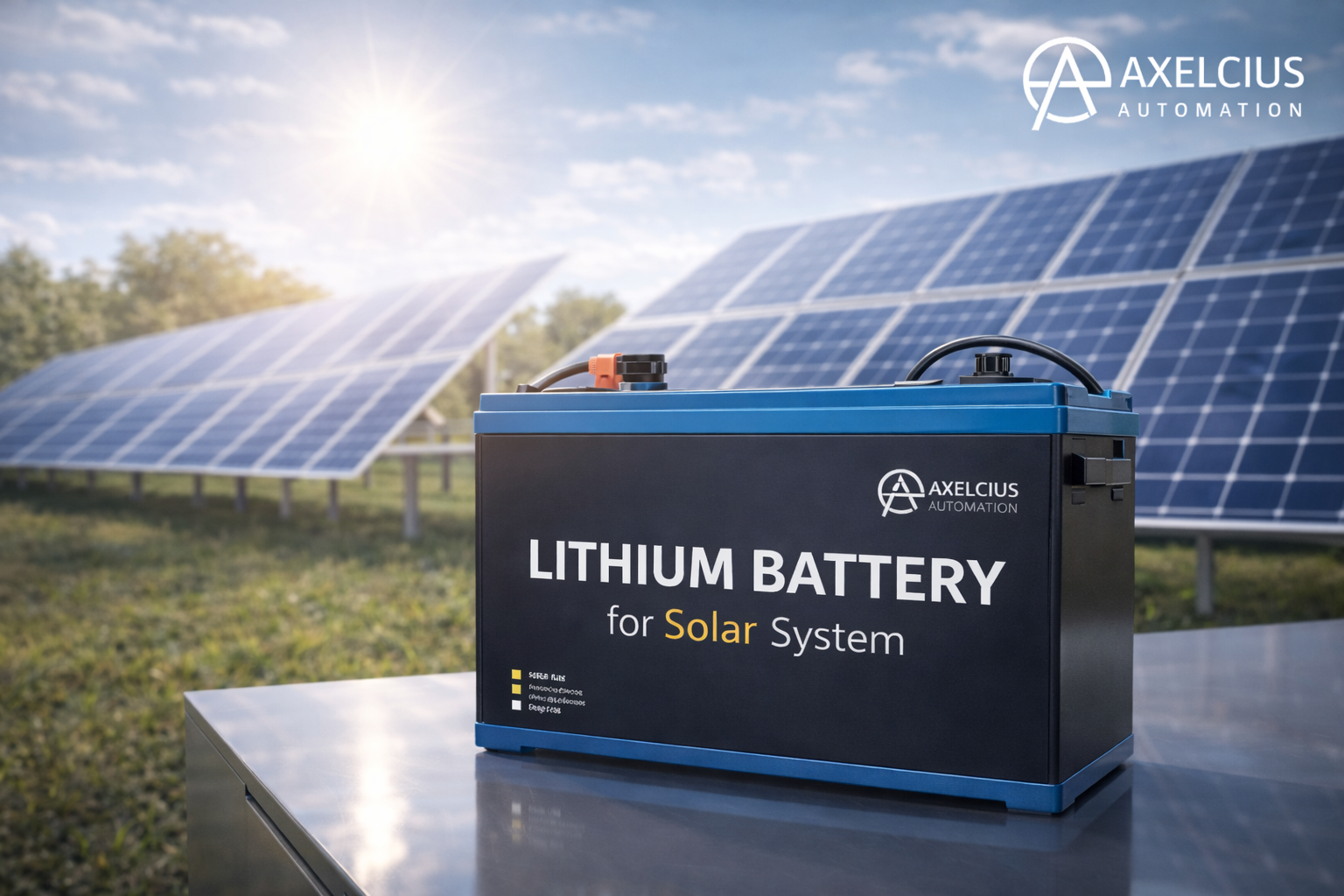
Almost one out of three residential solar systems incurs loss of viable energy daily due to the mismatch of storage capacity, a fact most novice buyers do not find out until they install their systems. It is that gap that is lurking there that makes the selection of the appropriate Lithium Battery for Solar System more important today than merely adding panels.
In homes, factories, and commercial rooftops, energy users are discovering that generation is not the key, retention yields whether solar really pays back. The unsuitably selected Lithium Battery of the Solar System can act as a big water tank and a small pipe: lots of stored energy, but it does not deliver when the demand is high. This explains why Lithium Ion Battery Manufacturers in India, Solar Solution Providers and even Industrial Automation Service Providers are more and more designing systems collectively and not independently.
Battery intelligence is impacting machine uptime, inverter communication, and energy forecasting, and this is also compared by modern buyers to support provided by Automation Solutions for Industries. A few of the best companies in industrial automation today recommend to clients that the software of the battery is as important as the chemistry of the battery.
A trustworthy Lithium Battery for Solar System enhances evening backup, appliance protection, as well as stabilizes the investment of solar over the years rather than seasons. It is not just about batteries any more. It is regarding the way intelligent storage reinvents all the rays of sunlight gathered.
A Lithium Battery to power a solar system would be efficient in houses where the evening power demand is high after the sunsets. The families tend to produce a sufficient amount of daytime power but use the majority of it during the office period, hence the need to store the energy. The battery does not drain superfluous power, but rather stores the energy like rainwater in a closed tank.
A Lithium Battery for Solar System is also relied upon in commercial offices to prevent short-term outages that disrupt networking gear and security systems. A three-minute outage is capable of re-initiating servers, disrupting billing systems, and decreasing productivity. The retail space is advantageous as the solar energy that is stored is used in refrigeration, lighting, as well as payment systems when the tariff is at the peak.
Factories are linking a Lithium Battery to Solar System with production scheduling software more and more. It is here that the Industrial Automation Service Providers assist in matching the machine cycles with battery discharge. In the case of cold storage units, the battery should not be able to generate energy abruptly. The irrigation systems in farms also have battery backup on the early morning pumping schedule. A Solar System Lithium Battery enables pumps to operate prior to the appearance of the sun when the demand for water starts.
The reason why lithium storage is preferred by hospitals and diagnostic centres is that voltage consistency ensures that delicate equipment is safeguarded. Even devices that are sensitive to calibration are damaged sooner than most operators feel comfortable with by a fluctuating backup source, which is why Solar Solution Providers tend to suggest modular battery banks in essential sectors. Warehouses with conveyor systems also combine storage with Automation Solutions for Industries to get continuous movement. Once battery systems are in communication with controllers, discharge ceases to be reactive and becomes predictable.
Higher usable depth of discharge is the greatest strength of a Lithium Battery to Solar System. In comparison with older types of batteries, lithium units frequently supply between 80 and 90 percent of the energy without serious reduction of lifetime. That implies that additional stored electricity is made available every day rather than being held up as a protected reserve.
A Lithium Battery Solar System also charges quicker, which is important in short winter sunlight. Imagine a bottle with a wide opening rather than a narrow neck. The quicker the energy comes in, the greater the solar production that is captured before sunset.
Another practical benefit is weight. Lithium units have a lower floor load which can benefit rooftop utility rooms and small inverter spaces.
Lithium Ion Battery Manufacturing in India is developing programs of slim wall-mounting on urban installations. This enables less cluttered designs in apartments and offices where space is costly.
A Lithium Battery to Solar System is also better in partial charging compared to normal storage, that is, the intermittent sunlight does not cut long-term efficiency as drastically.
Maintenance is another advantage that is not considered. No one has regular water filling, reduced risk of corrosion, and reduced ventilation issues. Best Companies in automation of industries usually prefer lithium since disruption of maintenance impacts on production planning.
The battery monitoring software is now able to predict the cycle behaviour beforehand. That is why a Lithium Battery for Solar System is an element of digital infrastructure, and not only a backup hardware.
| Feature | Lithium Battery (Solar System) | Lead Acid Battery | Gel Battery |
|---|---|---|---|
| Cycle Life | 4000–6000 cycles | 500–1200 cycles | 800–1500 cycles |
| Charging Speed | Fast | Slow | Moderate |
| Maintenance | Very Low | High | Moderate |
| Weight | Light | Heavy | Medium |
| Usable Capacity | High | Limited | Medium |
| Space Requirement | Compact | Large | Medium |
The average lifespan of a Lithium Battery for Solar System is four to five times longer than lead-acid counterparts when operating under equal conditions. That increased service life alters the economics of the project in general. Despite the fact that the cost of replacement is significantly reduced in ten years, the initial cost may seem more expensive.
This is frequently described by Solar Solution Providers as vehicle ownership logic: a greater initial cost may still lower the overall ownership cost. The same analogy is important in the factories where the cost of downtime is more than the cost of battery price variations.
A Lithium Battery Solar System also has a more constant voltage in discharge. That stability helps maintain inverter efficiency and the safety of attached electronics.
The decision of which Lithium Battery to use in a Solar System is not simply a matter of capacity printed on a label.
Battery management should be able to communicate with inverters, controllers and monitoring software properly, that is why the number of buyers who seek the consultation of the Industrial Automation Service Providers before installation grows.
It is possible to achieve a mismatch that will decrease the efficiency regardless of excellent battery quality. Load profile, backup expectations and charging patterns are checked by professional teams and then recommended size is given.
The value of automation solutions to industries lies in the fact that it will assist the batteries to respond intelligently to the machine demand.
The Lithium Battery designed to fit the Solar System also has thermal protection and remote diagnostics, which means possible problems are shown early in the form of alerts as opposed to failure breaking out.
The Lithium Ion Battery Manufacturers in India are currently collaborating with software teams in order to enhance predictive battery control.
The outcome would be improved charging during low-demand hours and improved discharge during high-cost grid hours.
Many of the best companies in the industrial automation industry now consider battery storage as an energy engineering, rather than an independent accessory, the wider perspective safeguards future performance.
The Lithium Battery for Solar System technology is moving toward the next generation that is smarter in chemistry and more sophisticated in safety layers. The reason why solid-state development is appealing to worldwide investment is that it offers increased density and reduced heat risk.
Advanced battery demand is projected to be three-fold by 2030 by industry analysts, electric mobility and solar adoption are both accelerating the growth. Very soon a Lithium Battery to Solar System will be able to hold much more energy in less space than the current standard packs. That can be beneficial to urban buildings in which installation space is still minimal.
Solar Solution Providers are also getting ready with hybrid systems, with batteries communicating with EV charging stations. This implies that daytime solar has the capacity to power buildings and vehicles. AI is finding its way into battery management as well.
Weather-based charging patterns can now be predicted by systems that are not affected by variation in sunlight. Industrial automation service providers are expected to become more involved in incorporating battery behaviour into factory dashboards. In manufacturing plants, battery response can shortly create automatic machine scheduling. Automation Solutions for Industries already tests adaptive discharge systems that react to tariff changes on an hourly basis.
Meanwhile, Lithium Ion Battery Manufacturers in India are increasing domestic manufacturing to minimize import reliance. That improves pricing and reduces delivery schedules. An enhanced local supply chain is also useful in supporting service after installation.
The Lithium Battery of Solar System is no longer backup equipment, and is now the financial backbone of any serious solar investment. There is no doubt that solar panels can be highly effective at capturing sunlight. However, storage is what defines the extent to which that energy can be retained until actual demand kicks in.
The right battery enhances stability, shields the equipment connected to it, and minimizes energy wasted in the long term. With the assistance of highly skilled partners such as Exelcius Automation, systems are smarter and more responsive in challenging operating environments. Verified solar solution suppliers understand that each installation is unique based on patterns of use and load priorities.
A warehouse, healthcare facility, farmhouse, and apartment building need to be supplied with various storage logic and battery size, this is the reason why the choice of the perfect Lithium Battery in solar system should never be made depending on the theory but the real consumption trends.
Proper planning today prevents unnecessary replacement expenses in the future, costly upgrades, and poor backup performance, the biggest energy systems do not necessarily have the strongest. These are the ones that are crafted with technical accuracy, reliable service services, and durability of operations.